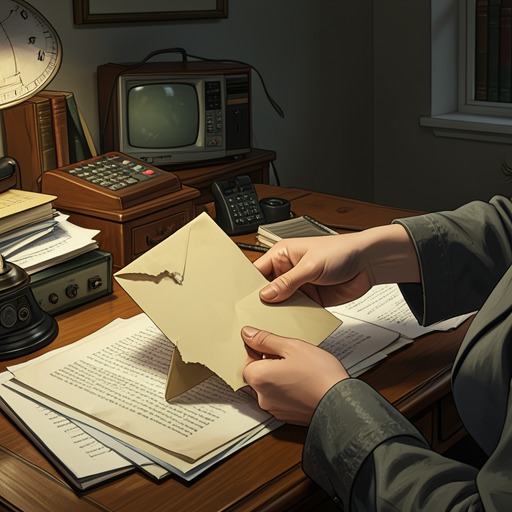
Creation and burning of Emily Inglethorp’s new will
The Mysterious Affair at StylesEmily Inglethorp’s new will is made in the aftermath of a violent quarrel, kept briefly in a purple box, and later destroyed in a bedroom fire. Its contents remain unknown, but its creation and disappearance become crucial to the murder inquiry: they raise questions about who stood to inherit, why the document was burned, and whether the timing supports or undermines the accusation against John Cavendish.
Background: Inheritance and war household
Emily Inglethorp’s earlier will, dated the previous August, left her entire fortune to her elder stepson, John Cavendish, after minor legacies to servants. That arrangement was described as a fair one because John was expected to maintain Styles, while his younger brother, Lawrence Cavendish, was due to receive a considerable sum under their father’s will when Emily died. The family’s financial interests therefore depended on both the terms of existing documents and the law governing their validity.
A complication was that Emily had remarried Alfred Inglethorp. Hercule Poirot established that English law automatically revoked her earlier will on remarriage; Mr. Wells confirmed that it was consequently null and void. The old document might look like a clear statement of her intentions, but it could no longer settle the inheritance. The legal rule gives the later, missing will particular force, while also making it essential to distinguish between what the family believed and what the documents could legally accomplish.
The household’s wartime economy supplies the practical conditions for the burning. Emily insisted that nothing be wasted, even scrap paper, which was collected and sent away in sacks. Dorcas recalled that Styles had employed only three gardeners during the war, compared with five before it. Against this culture of saving, a fire in Emily’s room on a hot day stood out as an unusual means of destroying a substantial document that could not simply be discarded with ordinary paper.
Creation: A witnessed signature
On the afternoon before Emily’s death, she called the gardeners, Manning and William, into the house while they were planting a bed of begonias on the south side. She had them sign at the bottom of a long paper, beneath her own signature. Blotting paper covered the writing above it, so neither man saw the contents; each signed where she directed, Manning first and William second.
Afterward, Emily slipped the document into a long envelope and placed it inside a purple box standing on her desk. The gardeners’ testimony establishes that a paper was signed and put away, but does not disclose its terms. The hidden text is central to the mystery: the signatures and envelope support the existence of a formal new will, while the covered writing prevents the witnesses from identifying its beneficiary or provisions.
The circumstances also give the investigation a small but concrete trail. Poirot connected an old envelope that had been scribbled over with the freshly planted bed of begonias, details that helped him infer that a new will had been made and that the gardeners had been called in as witnesses. The clue does not reveal the document’s contents; rather, it directs attention to the act of execution and to the otherwise ordinary work taking place outside the house.
Disappearance and discovery in the ashes
By the time the household began asking what had happened to the new will, the document had vanished. Poirot warned that Emily had taken its secret to her grave: she had told no one its provisions, and there had been no opportunity for the consultation she might otherwise have had with Mr. Wells. The loss left the family and investigators to reason from its circumstances rather than from its text.
Poirot searched the dead ashes in Emily’s grate, carefully sorting them into the fender. Using forceps, he extracted a small piece of half-charred paper. Its unusual thickness suggested to the narrator, Arthur Hastings, that it was a will fragment; Poirot confirmed the identification. The fragment established that a document had been burned, but did not restore its missing provisions or, on its own, establish who had put it into the fire.
The fireplace made the destruction legible as an action rather than a mere absence. Poirot emphasized that the day was one of the hottest of the year, with the temperature at 80 degrees in the shade, yet Emily had ordered a fire. Because the household saved waste paper, he reasoned, there was no ordinary way to dispose of a thick document such as a will. The exceptional fire therefore pointed to an effort to destroy an important paper, though Poirot initially drew the wrong conclusion about the order of events and the reason for the burning.
Competing accounts and consequences
The prosecution’s account at John Cavendish’s trial presented the new will as a document made after his quarrel with Emily and found destroyed in her grate the following morning. It alleged that evidence indicated the will had been drawn up in favor of Alfred Inglethorp, and suggested that Emily may have thought her earlier will had been revoked by marriage. The prosecution also linked John’s alleged financial desperation and the quarrel to a motive for murder. These were claims advanced in court, not information recovered from the will itself; the document’s text remained unavailable.
The defense challenged the implication that Alfred was the beneficiary of the new document and pointed instead to the legal rule that Emily’s remarriage had already revoked the will made in his favor a year earlier. Because Alfred had formerly practiced at the Bar, the defense argued that he knew this. It promised evidence identifying who destroyed the new will and suggested that this evidence could open a different view of the case. Thus the old will’s legal status and the missing will’s unknown contents became points of dispute, rather than straightforward proof of any one person’s motive.
The will’s creation and burning consequently perform two related functions in the narrative. They show how a change in family property arrangements could intensify suspicion, but they also expose the danger of treating an absent document as though its contents were known. The witnesses establish the signing; the ashes establish destruction; neither supplies the beneficiary. The mystery turns on the gap between those material traces and the confident interpretations built upon them.